How to stop your Power Platform from turning into shadow IT
Power Platform does not become shadow IT because people are reckless. It becomes shadow IT because useful things get built faster than the organisation’s ability to govern them.
That is fixable. But only if you treat Power Platform as an operational platform, not a collection of one-off apps.
Most organisations do not wake up one morning and decide to create shadow IT.
It happens more quietly than that.
A manager builds a quick approval flow because email approvals are painful. Someone in operations replaces a spreadsheet with a small Power App. HR creates a form for starters and leavers. Finance connects a report to a SharePoint list because the monthly process is too manual.
At first, it looks like progress. And to be fair, it is progress.
The problem starts six months later, when nobody can answer the basic questions.
Who owns this flow?
Which account is it running under?
Is this app using a premium connector?
What happens if the person who built it leaves?
Is the data sitting in SharePoint, Dataverse, Excel or somewhere else entirely?
Does anyone know if this thing is now business-critical?
That is the real Power Platform risk. Not that people are building. The risk is that the business starts depending on things that were never designed, documented or governed as business systems.
The problem is not low-code. The problem is unmanaged low-code.
Power Platform is one of the best things Microsoft has put in the hands of business teams. It gives people close to the work the ability to fix the work.
That matters.
The finance team knows where the month-end process breaks. The operations team knows which handover is still being tracked in a spreadsheet. The HR team knows which onboarding step creates the same question every week.
Low-code works because the people with the pain can help shape the solution.
But there is a line. Once an app is used by a department, stores sensitive data, triggers approvals, touches customer information or replaces a manual control, it is no longer a “quick app”. It is part of the operating model.
And if it is part of the operating model, it needs governance.
Not bureaucracy. Governance.
The difference matters.
Bureaucracy says, “Nobody can build anything unless IT approves every button.”
Governance says, “Build quickly, but inside sensible guardrails.”
That is the balance most organisations are missing.
The default environment is where good intentions go to become a mess
One of the most common issues we see is the overuse of the default environment.
It starts harmlessly. People open Power Apps, create something useful, and publish it where they are allowed to publish it. The default environment becomes the place where experiments, departmental tools, production workflows and abandoned ideas all live together.
That might be acceptable for a few small experiments. It is not acceptable once the business starts depending on those tools.
A mature Power Platform setup usually needs clear separation between:
- Personal experimentation
- Departmental development
- Testing and acceptance
- Production use
- Business-critical apps and flows
Without that separation, every clean-up becomes harder. Every permission review takes longer. Every licensing conversation gets more awkward. Every new maker inherits yesterday’s mess.
A messy Power Platform tenant does not usually fail in one dramatic moment. It creates a slow operational drag.
Apps become harder to support. Flows break silently. Owners leave. Licences creep. IT starts distrusting the platform. Business teams start hiding what they build because they fear everything will be blocked.
That is how a platform with huge potential becomes a political problem.
The five signs your Power Platform estate needs attention
You probably do not need a six-month transformation programme. But you may need a structured review if any of these feel familiar.
1. You do not have a reliable app and flow inventory
If you cannot see what exists, who owns it, who uses it and what data it touches, you cannot govern it.
An inventory is not admin tidying. It is the starting point for risk, support, licensing and prioritisation.
2. Critical flows still run under individual user accounts
This is one of the most common failure points.
Someone builds a flow. It works. Everyone forgets about it. Then the owner changes role, loses access, goes on long-term leave or leaves the business. Suddenly a business process stops and nobody knows why.
Business-critical automation should not depend on one person’s account.
3. The same problem has been solved three different ways
If three departments have built three separate onboarding trackers, you do not have innovation. You have duplication.
This is where Power Platform governance becomes commercially useful. It helps you spot repeatable patterns that should become reusable components, templates or proper accelerators.
4. Nobody can explain the licence impact before approving a new app
Power Platform licensing is manageable when it is designed early. It becomes painful when licensing is discovered after the app is already embedded in the business.
Premium connectors, Dataverse, Managed Environments and broader rollouts all change the commercial shape of a solution. The time to understand that is before adoption, not after.
5. There is no clear route from prototype to production
A good prototype is not automatically a good production app.
Production needs ownership, documentation, testing, support, data protection checks and a release path. If those steps do not exist, every useful prototype becomes a future support issue.
What good Power Platform governance actually looks like
Good governance is lighter than most people think.
It does not need to start with a 70-page policy. In most mid-market organisations, the first version can be surprisingly practical.
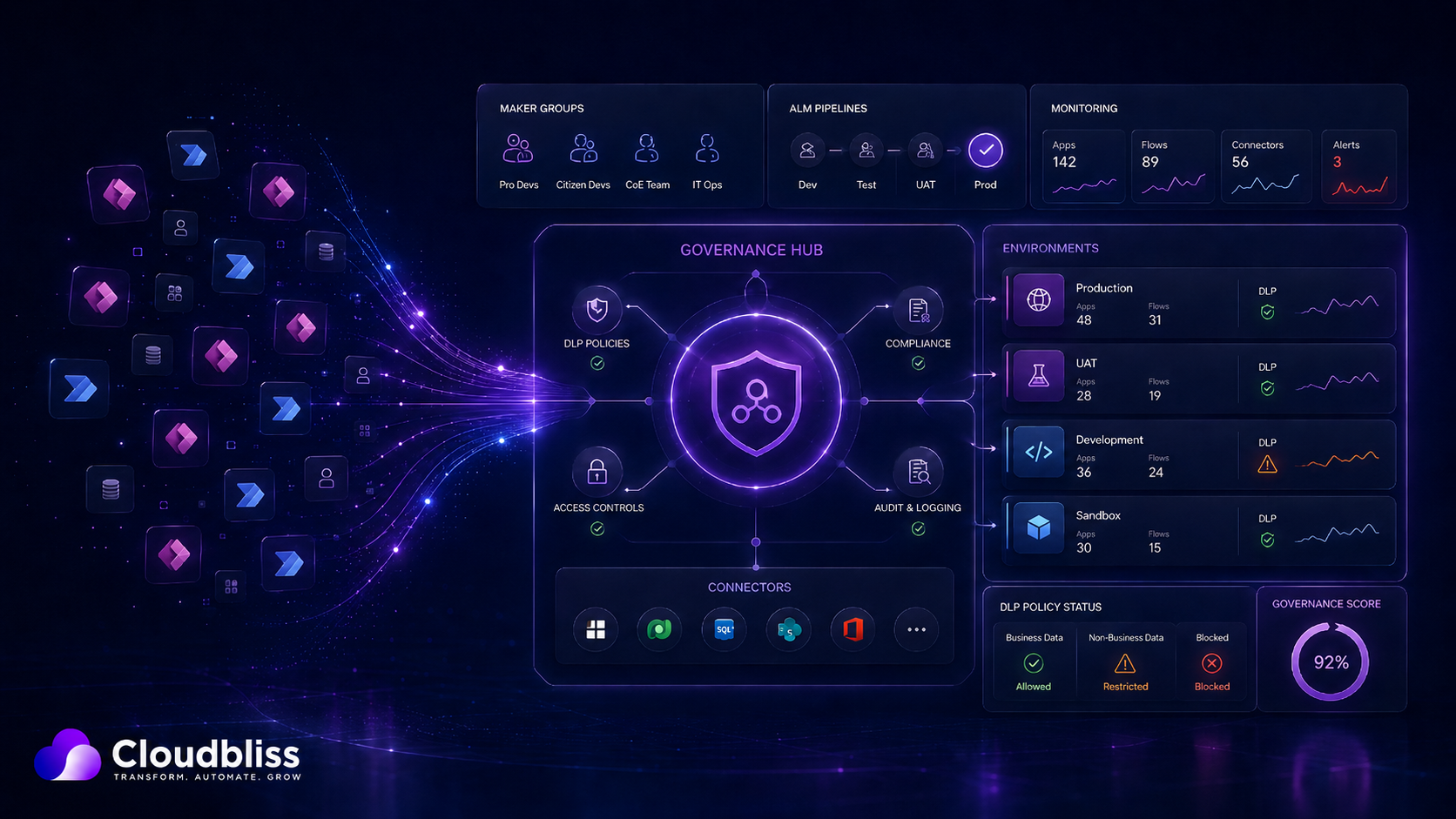
You need a clear environment strategy. You need a maker onboarding process. You need sensible Data Loss Prevention policies. You need a way to classify apps by risk. You need ownership rules. You need a production release path. You need a support model for the things the business now relies on.
Most importantly, you need to decide what sort of Power Platform organisation you want to be.
There are usually three models.
The controlled innovation model
Business users can build, but within clear boundaries. IT provides templates, guardrails and review points. This is often the best model for SMEs and mid-market firms.
The central delivery model
Most apps are built by a central IT or digital team. This gives more control, but can slow down smaller improvements.
The Centre of Excellence model
A more mature setup with governance, reusable components, maker communities, training, monitoring and structured ALM. This is powerful, but it needs proper ownership.
The mistake is pretending you have the third model when you have not even built the first.
A practical 30-day clean-up plan
If your Power Platform estate already feels messy, start here.
Week 1: Inventory the estate
Export the list of apps, flows, environments, owners, connectors and recent usage. Do not try to fix everything yet. Just get visibility.
Label each app or flow as one of four types:
- Experiment
- Departmental tool
- Business-use tool
- Business-critical process
That classification alone will make the next steps clearer.
Week 2: Find the obvious risks
Look for flows owned by leavers, apps with no recent usage, premium connectors, broad permissions, sensitive data, and anything running inside the default environment that should not be there.
You are not looking for perfection. You are looking for the issues that could break operations, expose data or create avoidable cost.
Week 3: Define the guardrails
Set your environment model. Decide where new makers build. Decide what needs review before production. Decide which connectors are blocked, allowed or restricted. Decide who can create production environments.
Write it in plain English.
If a non-technical department head cannot understand the rules, the rules will not work.
Week 4: Create the production route
Define how a useful prototype becomes a supported business tool.
That route should include:
- Named business owner
- Technical owner
- Data source review
- Licensing check
- Security and permission review
- Basic testing
- Handover documentation
- Support route
Again, keep it practical. You are building enough structure to protect the business without killing the reason people liked Power Platform in the first place.
The commercial reason to do this now
Governance is often sold as risk reduction. That is true, but incomplete.
Good Power Platform governance also improves return on investment.
It helps you reuse components instead of rebuilding the same thing. It helps you avoid licensing surprises. It gives IT confidence to support the platform. It helps business teams move faster because they know the rules. It turns scattered automation into an operating advantage.
That is where CloudBliss spends most of its time.
We are not interested in turning Power Platform into another slow enterprise approval machine. We are interested in helping organisations build useful operational tools quickly, safely and in a way that can survive beyond the person who created the first version.
Final thought
Power Platform sprawl is not a sign that the platform has failed.
It is usually a sign that the platform worked, and the business adopted it faster than governance caught up.
That is a good problem — if you deal with it early.
Ignore it for long enough and the estate becomes harder to clean, harder to trust and harder to scale. Put the right controls in place now and Power Platform becomes what it should have been from the start: a practical way to turn Microsoft 365 into a real operational engine.
If your Power Apps and Power Automate estate is already useful but starting to feel messy, CloudBliss can help you bring it under control without slowing the business down.
Book a discovery call or ask for a fixed-scope Power Platform Governance Review covering environments, ownership, app risk, flow reliability, licensing exposure and next-step recommendations.