Merging Two Companies, One Microsoft 365 Tenant at a Time
How Cloudbliss delivered a seamless M365 tenant-to-tenant migration as part of an M&A integration — on time, under budget, and with zero business disruption.
.avif)
The Challenge Every Acquirer Dreads
Mergers and acquisitions are exciting on paper. Two companies join forces, synergies are projected, and the leadership team celebrates. But behind the scenes, IT teams face a ticking clock. The Transitional Service Agreement has a hard deadline. The acquired company is running its own Microsoft 365 tenant with years of accumulated data, custom configurations, and workflows that hundreds of employees rely on every single day. Miss the TSA deadline, and the penalties can reach tens of thousands of pounds per day.
The reality is that somewhere between 70 and 90 percent of M&A deals fail to deliver their expected value, and poor IT integration is consistently cited as one of the top reasons. Email stops flowing. SharePoint permissions break. Teams channels vanish. Users lose access to critical files mid-project. These are not hypothetical risks — they are the day-to-day consequences of rushed or poorly planned tenant migrations.
Why Tenant-to-Tenant Migrations Are So Complex
A Microsoft 365 tenant is not just a collection of mailboxes. It is an entire digital ecosystem encompassing email, calendars, contacts, OneDrive files, SharePoint sites and libraries, Teams channels and chat history, Planner boards, Power Automate flows, sensitivity labels, conditional access policies, and Intune device configurations. Moving all of this from one tenant to another while keeping the business running is like performing open-heart surgery on a patient who needs to keep jogging.
Add to this the complications of identity management. Users need new credentials, devices need re-enrolling, MFA tokens need resetting, and every third-party application with an Azure AD integration needs reconfiguring. A single overlooked dependency can cascade into days of downtime and frustrated users flooding the helpdesk.
The Cloudbliss Approach
At Cloudbliss, we have delivered over 15 M&A IT integrations across thousands of users in sectors ranging from financial services to healthcare. Our approach is built on a methodology refined through hard-won experience, not theoretical frameworks.
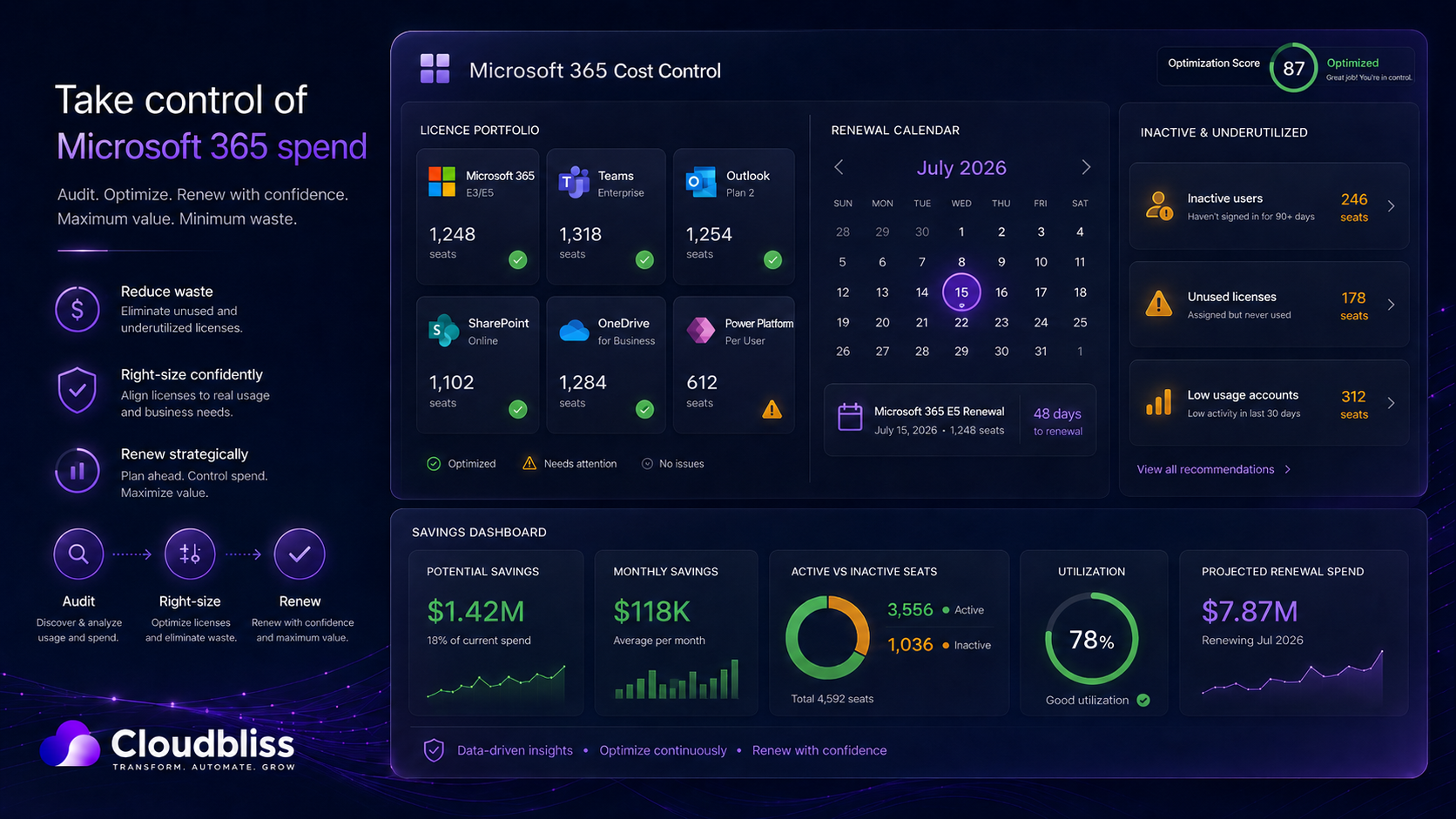
Phase 1 — Discovery and Planning. Before a single mailbox moves, we conduct a thorough assessment of both source and target tenants. We map every dependency, identify shadow IT, audit licensing for consolidation savings, and build a detailed migration runbook. We validate the TSA timeline against realistic migration windows and flag risks early. This phase typically includes our M&A Technology Readiness Assessment, a fixed-scope deliverable that gives leadership a clear picture of what they are dealing with.
Phase 2 — Coexistence and Foundation. We establish cross-tenant trust, configure mail flow coexistence so both domains continue receiving email seamlessly, synchronise the Global Address List, and set up Teams guest access. Users in both organisations can collaborate immediately without waiting for the full migration to complete.
Phase 3 — Pilot Migration. We select a representative group of 30 to 50 users and migrate their complete workloads: mailboxes, OneDrive, SharePoint, and Teams. This validates our tooling configuration, identifies edge cases, and gives us confidence in our timeline projections.
Phase 4 — Production Migration. Using BitTitan MigrationWiz for mailbox migrations and ShareGate for SharePoint and Teams content, we execute staged migrations in waves. BitTitan's incremental sync capability means we can pre-stage mailbox data days before the actual cutover, reducing the final switchover window to minutes rather than hours. ShareGate handles the complex permissions matrices and metadata preservation that native Microsoft tools often struggle with. We also leverage native Microsoft cross-tenant migration capabilities where appropriate, particularly for larger mailbox migrations where Microsoft's built-in tooling has matured significantly.
Phase 5 — Device and Security Transition. Devices are re-enrolled into the target tenant's Intune environment, conditional access policies are aligned, and security baselines are applied. Defender for Endpoint configurations are migrated to ensure continuous protection throughout the transition.
Phase 6 — Validation and Decommissioning. Post-migration, we run automated validation scripts to confirm data integrity, verify permissions, and ensure no orphaned objects remain. Once validated, we assist with source tenant decommissioning and license consolidation.
A Real-World Result
A private equity-backed acquisition required the integration of an 850-user company within a tight TSA window. The acquired business operated its own M365 tenant with complex SharePoint structures, legacy Exchange configurations, and no standardised device management. Cloudbliss completed the full migration two months ahead of the TSA deadline, saving the client an estimated £300,000 in extension fees. Email migration achieved zero data loss with less than 15 minutes of user-facing downtime per wave. The license consolidation exercise alone identified £45,000 in annual savings through the elimination of duplicate and unused subscriptions.
The Outcome
The merged organisation now operates from a single, secure Microsoft 365 tenant with unified identity management, consistent security policies, and a standardised collaboration environment. Users experienced minimal disruption, and the IT team inherited a clean, well-documented environment rather than a patchwork of compromises.
M&A IT integration does not have to be the value destroyer that statistics suggest. With the right methodology, the right tooling, and a team that has been through it before, it becomes a controlled, predictable project with measurable outcomes.
Ready to Talk?
If your organisation is planning an acquisition, divestiture, or merger and you need Microsoft 365 integration expertise, get in touch with the Cloudbliss team. We offer a fixed-scope M&A Technology Readiness Assessment that gives you clarity before you commit to a full migration programme.